
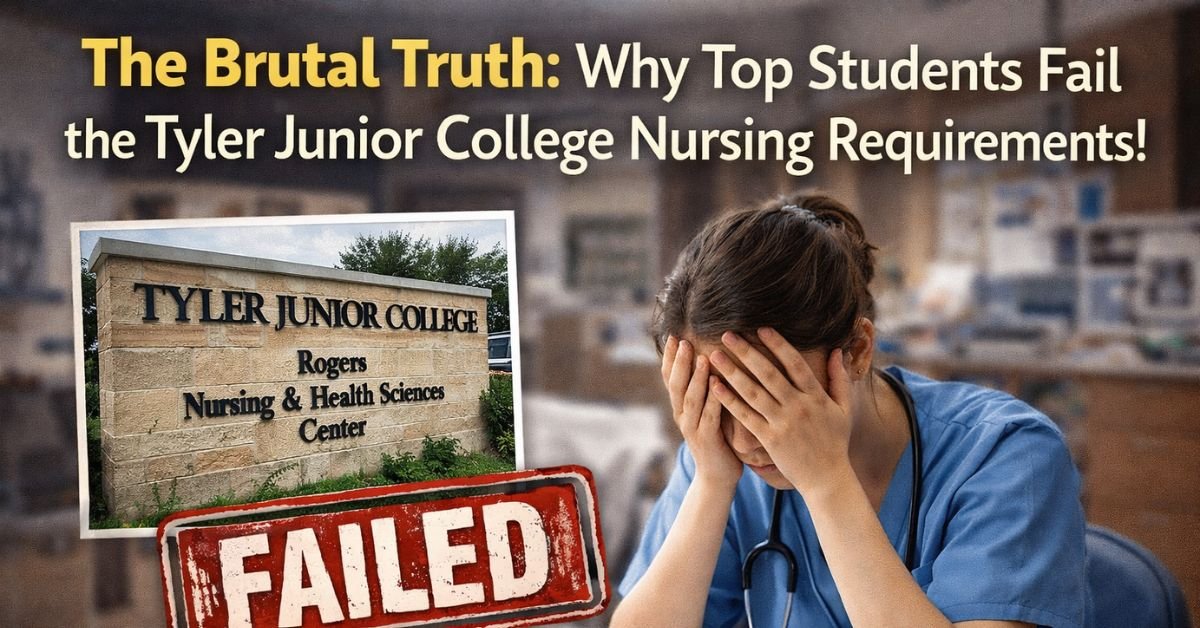
Every single semester, hundreds of hopeful and highly intelligent students submit their applications to East Texas’s premier healthcare programs, only to face unexpected and devastating rejection letters. If your ultimate dream is to become a registered nurse and secure a high-paying career in the medical field, understanding the exact tyler junior college nursing requirements is the absolute most critical step in your academic journey. This is not a standard college program where simply passing your classes and submitting a basic application guarantees you a seat in the classroom.
Nursing Admissions Master Suite
Applicant Analysis & Tracking Dashboard
Core Science Prerequisites
Enter your grades for the heavy sciences. These carry the most weight in your application.
ATI TEAS Readiness Check
Input your TEAS composite score to see how you rank against the applicant pool.
Clinical Compliance Tracker
Check off your completed documentation. Missing files will halt your admission.
The admissions committee utilizes a highly secretive, incredibly competitive, points-based ranking system. Your grades, your standardized test scores, and even your past legal history are put under a microscope. To help you secure your future, avoid the heartbreak of a denial, and save hundreds of dollars in wasted application fees, we have compiled this ultimate, unfiltered guide to exactly what it takes to get accepted into TJC this year.
Minimum vs. Competitive tyler junior college nursing requirements
When you look at the official college catalog or attend a basic advising session, you will be handed a list of baseline standards. However, you must understand a harsh reality: meeting the minimum tyler junior college nursing requirements rarely results in an acceptance letter because you are competing against top-tier scholars for a strictly limited number of clinical seats.
To give you a clear picture of where you actually need to stand to be considered a strong candidate, look at the comparison table below. This data separates the bare minimums from the actual averages of students who successfully receive an acceptance letter.
| Admissions Category | The Published “Minimum” | The Actual “Competitive” Standard |
| Overall Cumulative GPA | 2.5 on a 4.0 Scale | 3.4 to 3.8+ on a 4.0 Scale |
| Science Prerequisite GPA | Grade of “C” or better | Mostly “A”s with one or two “B”s |
| ATI TEAS Exam Score | Proficient Level (Approx. 58%) | Advanced Level (78% to 85%+) |
| Healthcare Experience | Not officially required | Highly preferred (CNA, EMT, MA) |
The Essential Science Prerequisite Trap
Before you can even unlock the application portal, you must conquer the prerequisite phase. The admissions board scrutinizes these specific grades heavier than any other factor in your academic history. A “C” in Anatomy might be enough to pass the class and earn college credit, but it will severely drag down your nursing application ranking points.
If you want to be safe, you need to dedicate all your energy to mastering these foundational science courses before applying. Here is the breakdown of the exact classes you must complete:
| Course Name & Number | Credit Hours | Importance to Nursing Application |
| BIOL 2401: Anatomy & Physiology I | 4 Credits | Critical: Forms the basis of human body systems. |
| BIOL 2402: Anatomy & Physiology II | 4 Credits | Critical: Advanced physiological processes and chemistry. |
| BIOL 2420: Microbiology | 4 Credits | High: Understanding pathogens, sterilization, and disease. |
| PSYC 2301: General Psychology | 3 Credits | Moderate: Required for understanding patient behavior. |
Many students make the fatal mistake of taking Anatomy I and Microbiology in the exact same semester to save time. Unless you do not have to work a full-time job, this is a recipe for earning “C” grades. Space your sciences out so you can guarantee “A”s.
Conquering the ATI TEAS Exam Gatekeeper
The Test of Essential Academic Skills (TEAS) is the ultimate gatekeeper of the nursing world. Navigating this rigorous standardized test is a mandatory phase of the tyler junior college nursing requirements. You cannot just wake up, drink a cup of coffee, and pass this exam. It requires months of dedicated preparation.
The TEAS tests you on four distinct categories: Reading, Mathematics, Science, and English and Language Usage. The science portion is notoriously difficult because it pulls highly specific questions from Anatomy and Physiology that you may have forgotten. If you score below the national average, your application is immediately discarded before a human counselor even reads your name. You should invest in official ATI study manuals, take multiple timed practice exams, and aim for a minimum of 80% overall to secure maximum admission points.
Strict Immunizations and Background Clearances
Getting past the academic filters is only phase one of your journey. The Texas Board of Nursing enforces incredibly rigid background checks to protect vulnerable patients. A significant portion of the tyler junior college nursing requirements involves proving you are physically, mentally, and legally fit for hospital clinical rotations.
You will be required to use a third-party compliance system (like Complio) to upload a massive portfolio of documents. If a single document is missing or expired by one day, your clinical placement will be revoked.
| Compliance Requirement | Details and Expiration Rules |
| Criminal Background Check | Fingerprint-based through the Texas Dept. of Public Safety. |
| Drug Screening | 10-panel negative urine drug screen required prior to start. |
| TB (Tuberculosis) Test | Must be a negative test within the last 12 months. |
| Immunization Titers | Blood tests proving immunity to MMR, Varicella, and Hep B. |
| CPR Certification | Must be American Heart Association Basic Life Support (BLS). |
If you have any prior criminal history, including minor misdemeanors from years ago, you must file a Declaratory Order with the Texas Board of Nursing immediately. This process can take up to six months, so do not wait until the application deadline to start.
Building a Bulletproof Application Strategy
To maximize your chances of success, you need to treat this process like a high-stakes corporate job interview. Do not wait until the last minute to request your official college transcripts. Prepare for the TEAS test at least three to four months in advance of the application window. Gather your medical immunization records from your childhood doctor today, as blood titer results can take weeks to process.
By deeply understanding the competitive nature of these programs, spacing out your heavy science classes to protect your GPA, and preparing meticulously for the TEAS exam, you will position yourself ahead of thousands of other applicants. Secure your future in healthcare by mastering the rules before you ever submit your paperwork.
Frequently Asked Questions (FAQs)
1. What are the core tyler junior college nursing requirements for the ADN program?
The foundational prerequisites include the successful completion of Anatomy & Physiology I and II, Microbiology, and General Psychology with highly competitive grades, alongside a strong passing score on the ATI TEAS exam.
2. How long does it take to complete the tyler junior college nursing requirements?
If you are attending college full-time, it typically takes two to three semesters to finish all the necessary prerequisite courses, take the TEAS exam, and gather your medical clearances before you can officially apply.
3. Do the tyler junior college nursing requirements mandate a criminal background check?
Yes, absolutely. The Texas Board of Nursing requires a highly intensive fingerprint-based criminal background check and a mandatory clean drug screening before you are permitted to step foot inside a clinical hospital setting.
4. What happens if I fail the ATI TEAS exam on my first try?
TJC generally allows applicants to retake the TEAS exam, but there are strict limits on how many times you can test within a single application cycle. You must submit your highest valid score before the deadline.
5. Are online science prerequisites accepted by the admissions committee?
Yes, online courses are generally accepted, especially from accredited Texas colleges. However, many competitive applicants prefer taking sciences with in-person lab components to ensure they fully grasp the material needed for the TEAS exam.